Patternless
Bicolor
Flame
Tiger


Brindle
About Me

One solid color with no patterns.

Similar to bicolor but the base color creates a pattern in the dorsal. Little to no pattern on the sides or limbs.
Flame

Light base color with darker vertical lines that are sporadic and broken.
Two shades of the same color. The dorsal is lighter. or darker than the rest of the body but there is no pattern in the dorsal area.


Similar to a flame but with more pattern. Pattern extends outside the dorsal down the sides (laterals) and limbs.

Basically a flame with little pattern on the dorsal and ~80% pattern on the upper laterals.

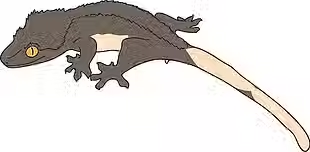
Highly white gecko. Viewed from the top, the tail is usually solid white. Bellies are a cream/white color which extends up the lower laterals. They have a row of raised scales on their sides and often have white knuckles.

This morph does not have any yellow, orange or red pigment. They only have black, blue, white, gray or silver colors.
Common Morphs
Graphic credit: Erica Yamamoto
Patternless
Bicolor
Tiger
Extreme
Harlequin
Axanthic
Brindle

Crested geckos are available in a remarkable array of different colors and patterns (54 according to MorpMarket), called morphs and traits. Unlike many other species of reptiles that use simple dominant and recessive traits, crested geckos are polygenetic, which means they use multiple genes to determine their appearance. Since the offspring inherit the traits from both parents, it can be challenging to predict the appearance of the offspring.
Morph vs. Trait?
The term morph refers to a specific combination of color and pattern (think of a model of car). A trait describes smaller, more specific features (think of leather seats) that can be passed from parent to offspring.
Traits can be combined with morphs.
Dalmatian spots
Super Dalmatian
Confetti Dalmatian
Dalmatian
Full Pin Stripe
Partial Pinstripe
Inkblot Dalmatian

Light base with dark bands that run from one side over the back and down the other side. Usually beige or brown.
Dalmatian spots are dark spots that can appear on any morph. Spots may increase and become more prominent with age.


True dalmatians have at least 25 to 50 spots om their body.
To a be a super dalmatian, the gecko needs to have to have at least 100 spots.

Confetti dalmatians have even amounts of three or more different colors of spots.

This is a variation of the dalmatian trait where the spots are larger and resemble ink blots or smudges.

Proven Genes
Lilly white and Axanthic: are co-dominant and recessive genes. The percentage of offspring that will be lily white or axanthic is predictable (depending on the parents). Lilly whites should never be bred together as this results in high mortality.
Lilly White
In addition to the standard pinstripes, quadstripes have two clearly defined lines along the top of the lower lateral area of the body.

Superstripes display five perfect stripes. There are two pinstripes, two quadstripes, and one clear, defined dorsal stripe. This is a recessive trait.

Morphs & Traits
The full pinstripe trait has two rows of 100% unbroken pins down each side of the dorsal. There are no breaks in the row of pins.

Quadstripe
On a partial pinstripe, the row of pins is broken so that it is less than 90% complete. If there are large gaps, then it would be a pin-dashed.

Reverse pinstripes are non-structural stripes that are darker and run just below the dorsal scales. This trait can be present along with other pinstripe traits.

Reverse Pinstripe
Common Traits

Tri-Color
Harlequin
These are harlequins that have three distinct colors.
Harlequin
Image Credit: Fluffy Dragons
Image Credit: Fluffy Dragons
Super Pinstripe
This is a trait where the lighter dorsal color pattern appears to drip down onto the sides of the gecko. Usually seen in harlequins, tri-colors, pinstripes, and lily whites.
Drippy



Portholes are white or cream colored raised scales that resemble dots on the sides of the gecko's body.

White Wall
Fringe
Knee Caps
Portholes
Creamcicle
Blushing is a pink or red hue that develops on the underside of the gecko's throat when it is fired up. This temporary blush of color fades when the gecko is no longer fired up.

Blushing

Credit: WimperGecko

Common Base Colors
Image Credit: Fluffy Dragons


Halloween
Yellow
Lavender
Red
Brown
Cream
Olive
Black
Creamsicles are complex, but basically they have a yellow base and a white cream pattern and dorsal.
A halloween crestie has a striking combination of a jet black base with bright orange markings. I true halloween lacks any white or yellow colors.
Credit: LizardBeans
Credit: WimperGecko
Unlike a full pinstripe, only 50-99% of the raised scales are highlighted. This creates a dashed line of raised cream colored scales on each side of the dorsal to the tail.
Tri-colors is a trait associated with the harlequin morph. Tricolors have three distinct colors, not including white spots, portholes or quadstripes. The dorsal is not included as a separate color, but usually looks like the dorsal of a harlequin.